New Amp Demos

Here is the first demo of my new battery powered amp  described in the last few posts – more demos to follow this week.

The tracks will all be recorded on a Tascam handheld recorder with the built in  MICs @ 1 foot from the speaker.

Demo 1 : No reverb – jazz tone on floating pickup arch top – simple chord melody

https://circuitsalad.com/wp-content/uploads/2013/04/walking-my-baby-home.mp3

Demo 2: Old beater electric guitar, small room reverb, lot of treble, bridge pickup and noodling around on B minor. As a side note: I am also using  some compression with the newest opto-compressor described in a previous  post.

https://circuitsalad.com/wp-content/uploads/2013/04/bathroom-tile-blues.mp3

Some Possible Value Mods for the Simple Opto Compressor

There is another builder/designer Jon who has experimented with a number of my compressor circuits. He recommends a lower value for R1 of around 22k instead of the 100k in the schematic. This will lower the max compression a little, but will help with stray capacitance roll-off of high end.  It should work fine.  It will load the guitar pickups a little with heavy compression. Also the diode peak detector is biased in a more linear range by changing R8 and R6  from 470k to 47k and C7 from 1uF to 10uF. I think these values will work a little better.

Over my choices are:  100K for R1,  47K for R6 and 10uF for C7

More Amp Updates – Revised schematic – Very minor mod to PCB – this should be it!

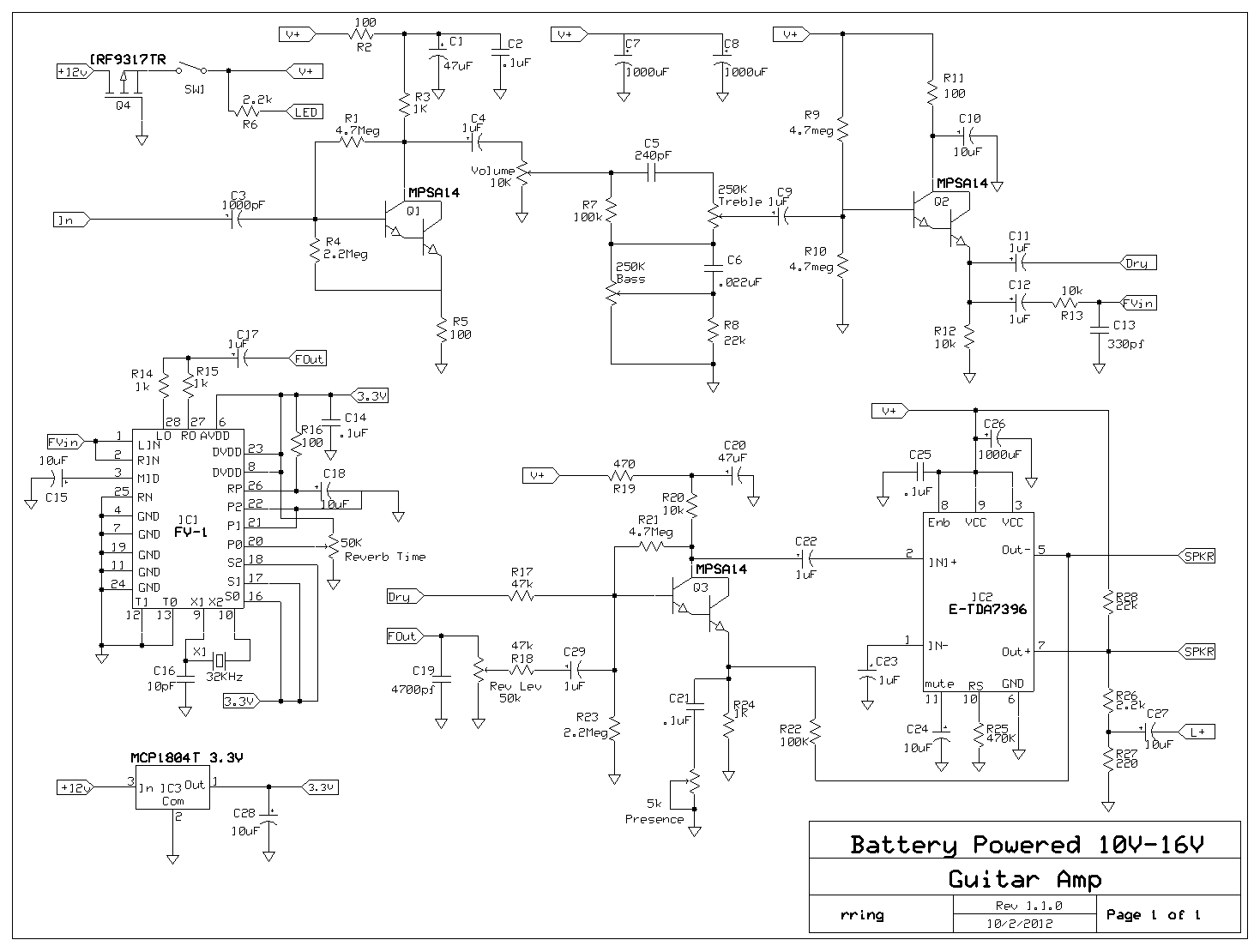
I have one guitar that belts out a huge signal from the neck pickup. I was able to  make the first stage just start to distort. To correct this,  I have changed R5 to 1K and R3 to 4.7k  also I have un- bootstrapped R4 and directly connected to ground. I thought the bootstrapping was a good idea – I must have eaten too many Twinkies that day.  C30 and R29 are still optional but could be used to give treble boost or hi/lo gain boost etc.

If you have already obtained the earlier board rev, you need to cut the trace from the emitter of Q1  going to R4 and ground that side of R4 to the ground plane.

I am posted a link to the new board rev here and obsoleting the schematic and layout in the old post. All I did was eliminate this trace and add a couple of wire connection pads to allow making R29 a POT for variable gain. If you have the old board it will work just fine – with the mod described above.

Updated Schematic:

https://circuitsalad.com/wp-content/uploads/2013/03/portaamprev1-1-1.gif

Updated Layout:

http://www.fileswap.com/dl/EDZsklrqcT/

Couple other minor notes: C16 may need to be increased to 22pF or so if you have a sluggish crystal –  had one out of five that needed the bigger cap. Also with the mods above you may find that C21 should be increased to .22uF or more depending on the range and level of treble boost desired.

Important component value changes in the Battery AMP

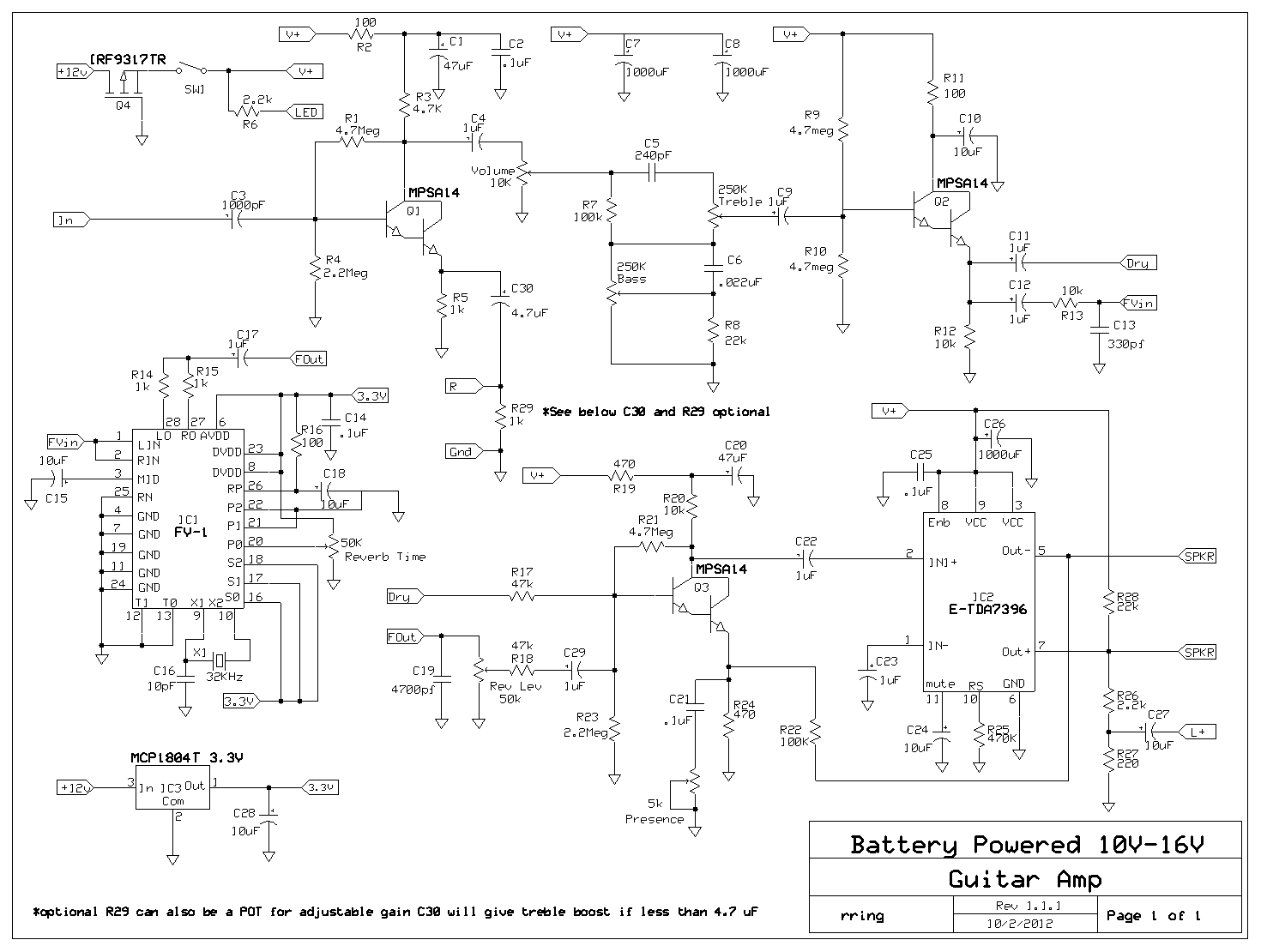
I think the amp has better head room for high output guitar pickups and better overall balance in the tone, when I attenuate the bass a little and remove the treble boost. This means making C3 1000pF instead of 1uF and eliminating R29 and C30. The  schematic below reflects these changes.

New schematic with minor changes in values:

https://circuitsalad.com/wp-content/uploads/2013/03/portaamp3a.gif

Fortunately the layout remains the unchanged!

Gain distribution is tricky in this amp, partly because of the low voltage supply and the need to not over drive the FV-1.  Some may have trouble with the first preamp being overloaded with hot signals. Increasing the emitter resistor R5 in the first stage and lowering it in the last R24 may help with this. The overall point here is that there is lots of room for adjustment.

Portable Battery Amp – thru-hole version Schematic and layout link

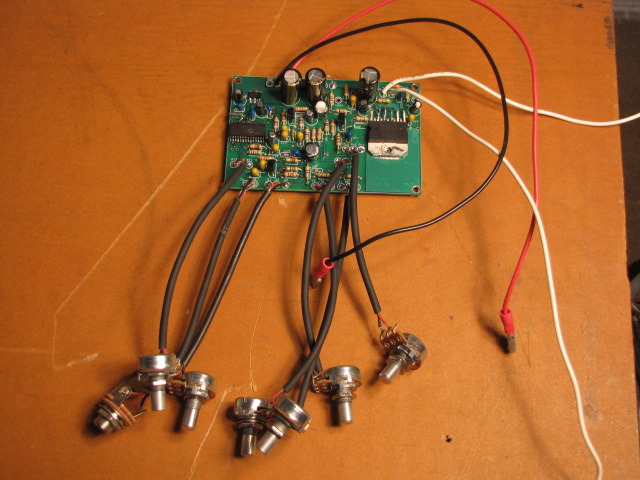
Took me awhile, but here is the new design. It’s very similar to my original design https://circuitsalad.com/2012/08/31/20-watt-battery-powered-guitar-amplifier-circuit/. I am still  using the FV-1 DSP chip for reverb which sounds great – but you can leave it out. I moved the position of the volume control after the first preamp and this helps the loading of the guitar and improves the noise figure a bit. I added a presence control in the negative feedback loop between the final amp the driver stage – this really adds some nice high end sizzle – if that’s your thing. The topology including: the fender type tone stack and the output feedback from the speaker back to the driver is much like a classic tube amp and to my ear has a nice sound. One big change was the replacement of the JFET preamp stages with Darlington transistors. You can make your own out of two generic npn’s or use another than the one I specified. Alternatively, you can use a Mosfet like a 2N7000. This may require some adjustment of the biasing. The reason I changed this was that the JFET biasing from device to device was fussy and so my schematic biasing values did not always work out correctly. The Darlington biases very consistently and I love the sound. Another reason was just for the fun of it ( don’t usually use the Darlington much).

Lots of options to adjust the tone stack, treble boost  in the first stage, the feedback loop on the final and the reverb tone shaping. I am sure if someone puts some effort into it, they can dial in some further improvements. The FV-1 has multiple selectable effect programs. The last reverb program is hard wired( all three pins pulled high) but these traces are on the bottom and can easily be cut. There are ground connections right next to these pins so that  one can cut a given trace and connect the pin to ground,  changing the program.  The FV-1 has a good data sheet and explains this in more detail.

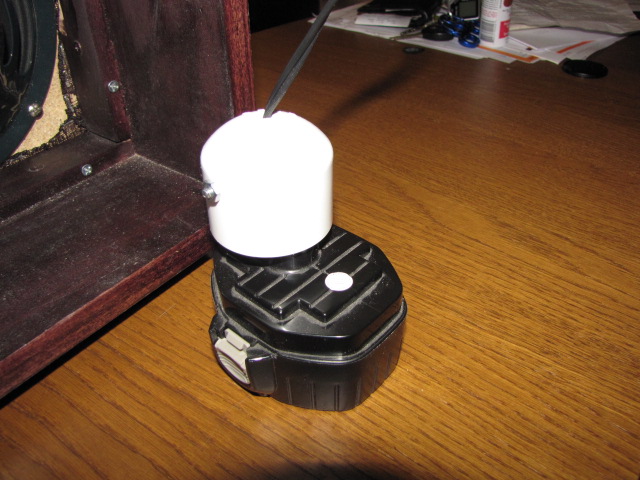
The final amp is the TDA7396 which is capable of cranking out up to 65 watts(2 ohm speaker) – it is easy to work with and current in production. It works well with 10 – 16 volts and in this design is intended to be used with a generic SLA 12 volt battery or  a 12-14 volt @ 3 amp supply.

There are only a few surface mount parts, the PMOS FET I use for polarity protection, the FV-1 and the 3.3volt regulator. The polarity protection can be left out or a rectifier can be used instead. Other 3.3v regulators can  be used also. If you leave off the FV-1 – you don’t need the regulator at all or the two reverb controls, and it will just work as is.

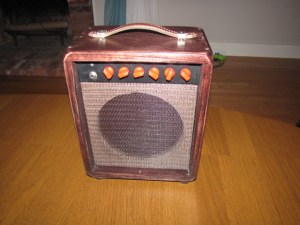
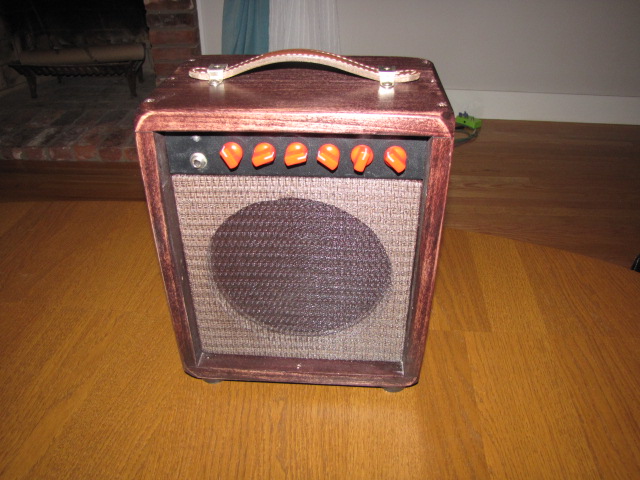
the controls on the AMP are: Volume, Treble, Bass, Reverb room size, Reverb level and Presence.

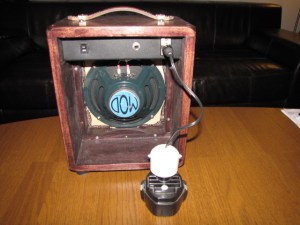
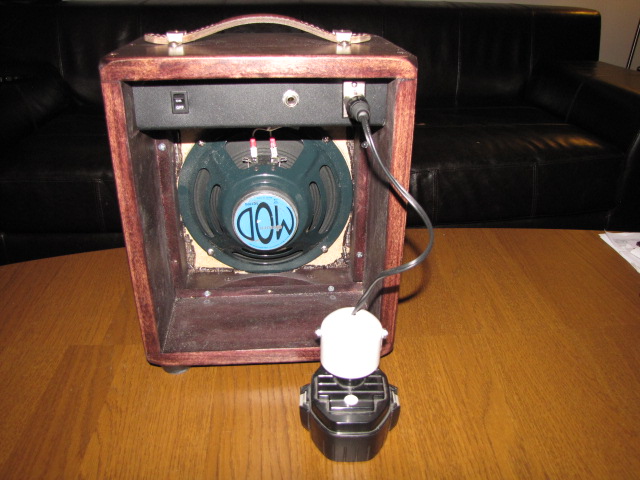
For the speaker I used a $22 Jensen 8″ MOD 4 ohm. I highly recommend this speaker – its cheap and sounds just right for this amp.

Go here for the correct schematic and layout:

http://www.circuitsalad.com/2013/03/27/more-amp-updates/

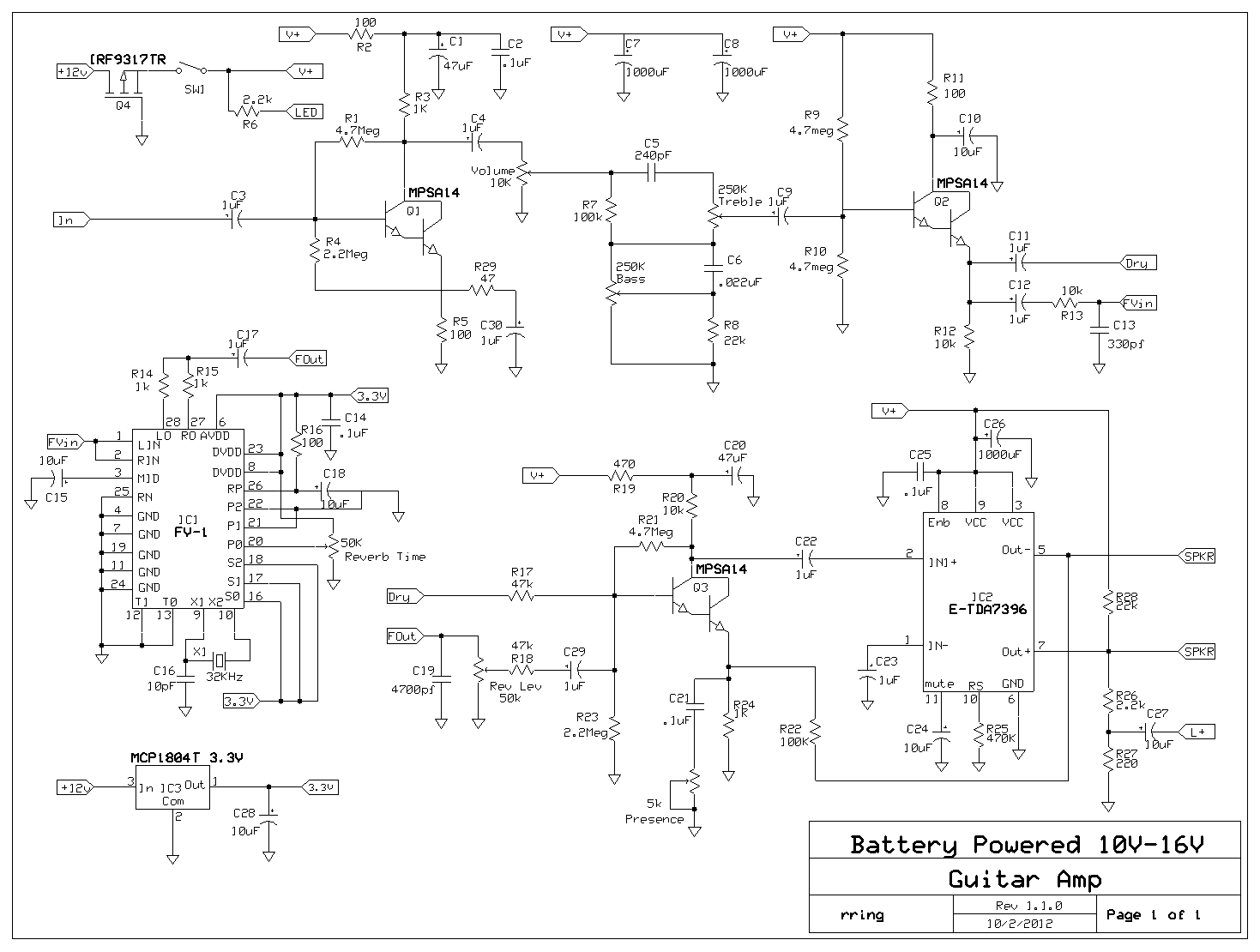
Schematic: 

https://circuitsalad.com/wp-content/uploads/2013/03/portaamp31.gif   (updated in later post – do not use)

Link to the expresspcb layout:

http://www.fileswap.com/dl/mp258DXnm/ (updated in later post – do not use)

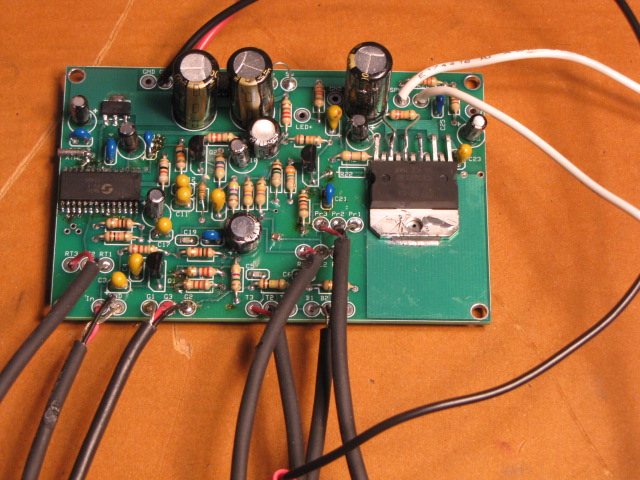
Prototype Images (the posted board artwork is slightly different than what is in this image because of corrected errors):
IMG_5307

IMG_5305

IMG_5313

New Amp Completed

IMG_5318

New Amp Showing Back

IMG_5319

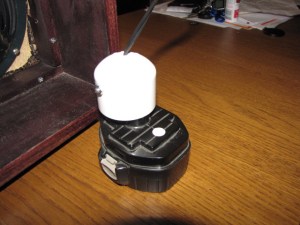
14.4V Drill Battery Power Pack

Sound Clips: (coming this week)

The OPTO compressor revisited simple and works well

I have been playing with all sorts compressor ideas and the circuit below is about the simplest thing I have come up with that works well. It uses just a handful of parts and needs no critical adjustments. It has fast attack and slow decay – which I find the most useful  for guitar.

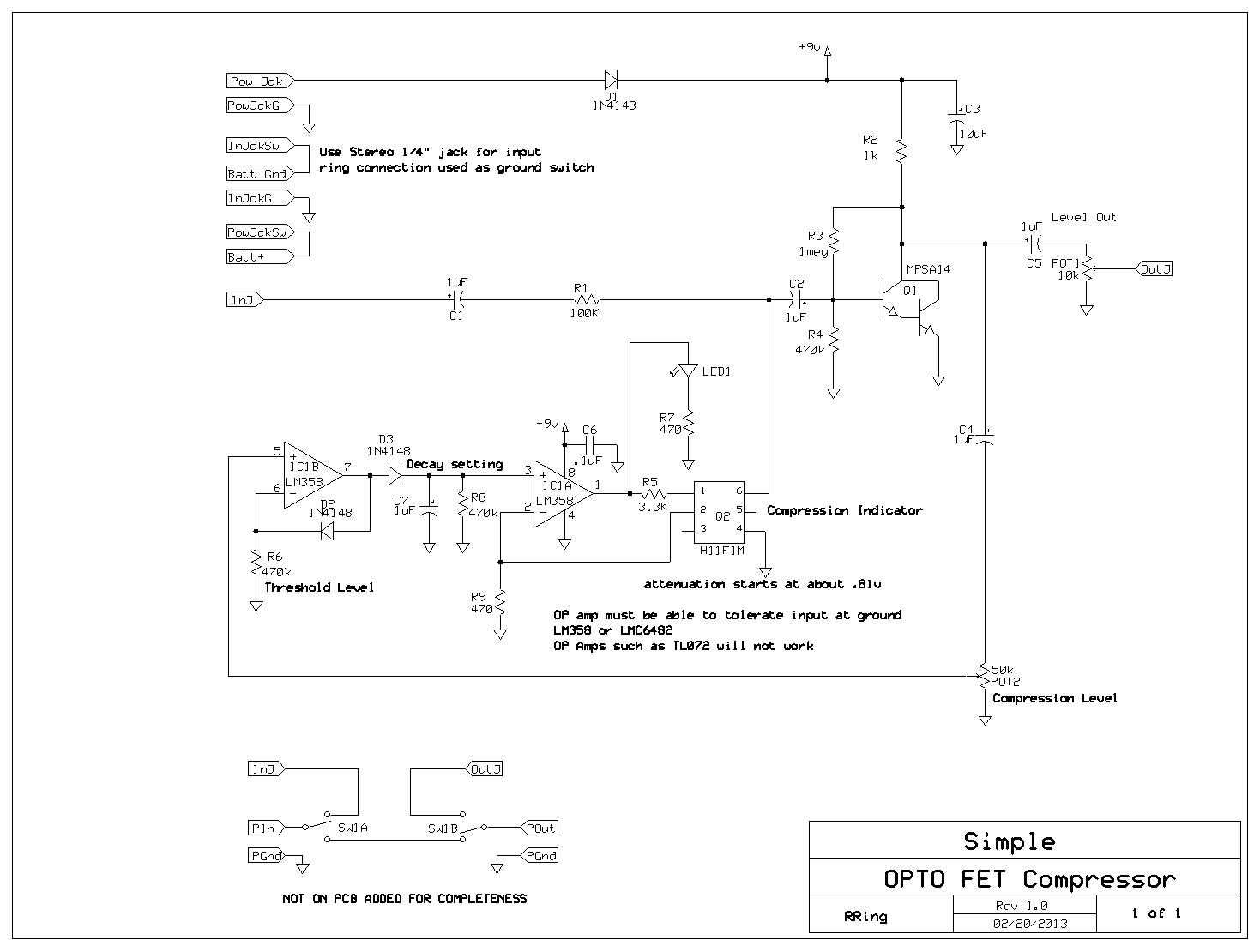
here is the schematic:

https://circuitsalad.com/wp-content/uploads/2013/03/simple-opto-comp1.gif

Additional notes here:

https://circuitsalad.com/2013/03/30/some-possible-value-mods-for-the-simple-opto-compressor/


link to ExpressPCB layout:

http://www.fileswap.com/dl/PFYBP3Gwp4/

It utilizes a number of features from my other designs and I have also integrated some suggestions from other designers (like using a darlington for the amp stage).

This design has the folowing features:

a  H11F1m OPTO FET variable resistor to control gain.

a darlington transistor as a shunt/shunt feedback amplifier. The biasing and feedback (from the collector to base) is critical to the design. The reason is that it keeps the voltage across the OPTO FET very low so as to keep it’s behavior linear. With out this feedback – there can be distortion.

LM358 beef stew op amp as a compensated diode peak detector and as a current mode amplifier the drive the H11F1m OPTO FET variable resistor.

The LED indicator is tied to the compression feedback loop and indicates compression level with variable brightness.

Demo  comming soon.

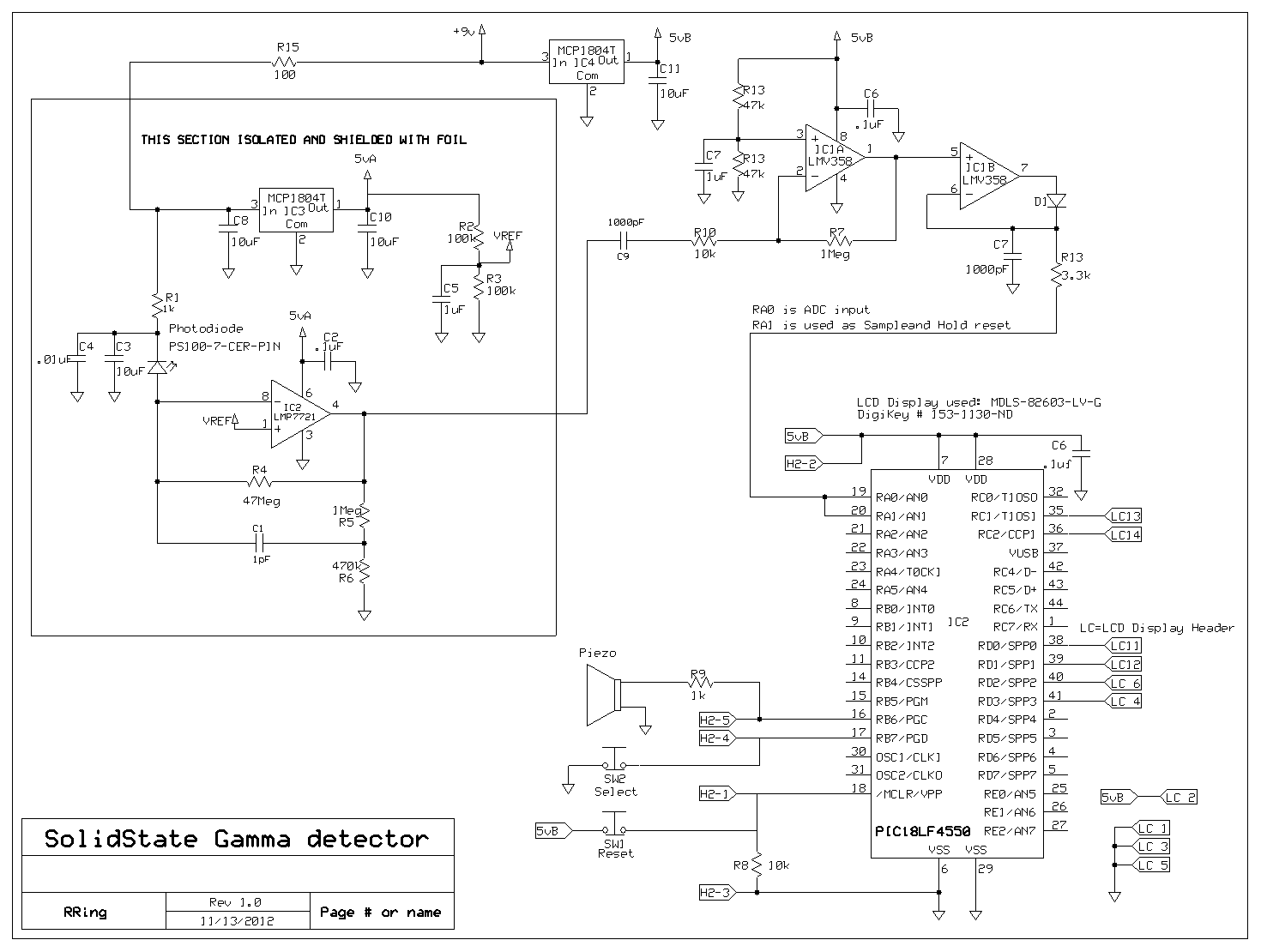
Solid State Radiation Detector with LCD Complete!

I added a PIC and LCD to my basic radiation detector and can now display total counts over time(up to 24 hours) or Counts/Sec and relative gamma strike energy level. The energy level varies as every gamma strike does not dislodge the maximum possible number of charge carriers. I take the maximum value registered every second and display. On average various materials indicate different levels, providing a crude detection signature. Besides the LCD display, this circuit has a sample and hold circuit which  is connected to  the PIC ADC module and also tied a another PIC I/O pin which switches from tristate to pulled low to reset the sample/hold circuit. The maximum sample rate is 13500 samples/per sec.

IMG_5261

Link to Schematic:

https://circuitsalad.com/wp-content/uploads/2013/01/dsp_geiger.gif

Link to Video Demo:

Link to Code and pcb files:

https://www.adrive.com/public/yrjs3G/DSP%20GEIGER%20COUNTER.zip

Thru Hole Version of Improved PT2399 Delay PCB Available Now

Check out earlier posts to learn more about this device and see and hear demos. I can’t say enough about how happy I am with this design! The only surface mount part is the MAX 7401 IC which is a SOIC8 and easy to solder.

Go to the link below to download the express pcb file. You can use this, modify it and have the board produced quickly by www.expresspcb.com at a reasonable cost. Check out there site for more detail if you are not familiar with the service

link to zip file with schematic and layout info:

https://www.adrive.com/public/PeAeX9/PT2399%20delay%20files.zip

Here is a picture of the layout to scale:

analog_delay_PCBThe Board Layout can easily be altered add PCB Jacks, or resize, etc. Currently it is sized to fit in a 1590B type stomp box.

Simple Mosfet Compressor MODs

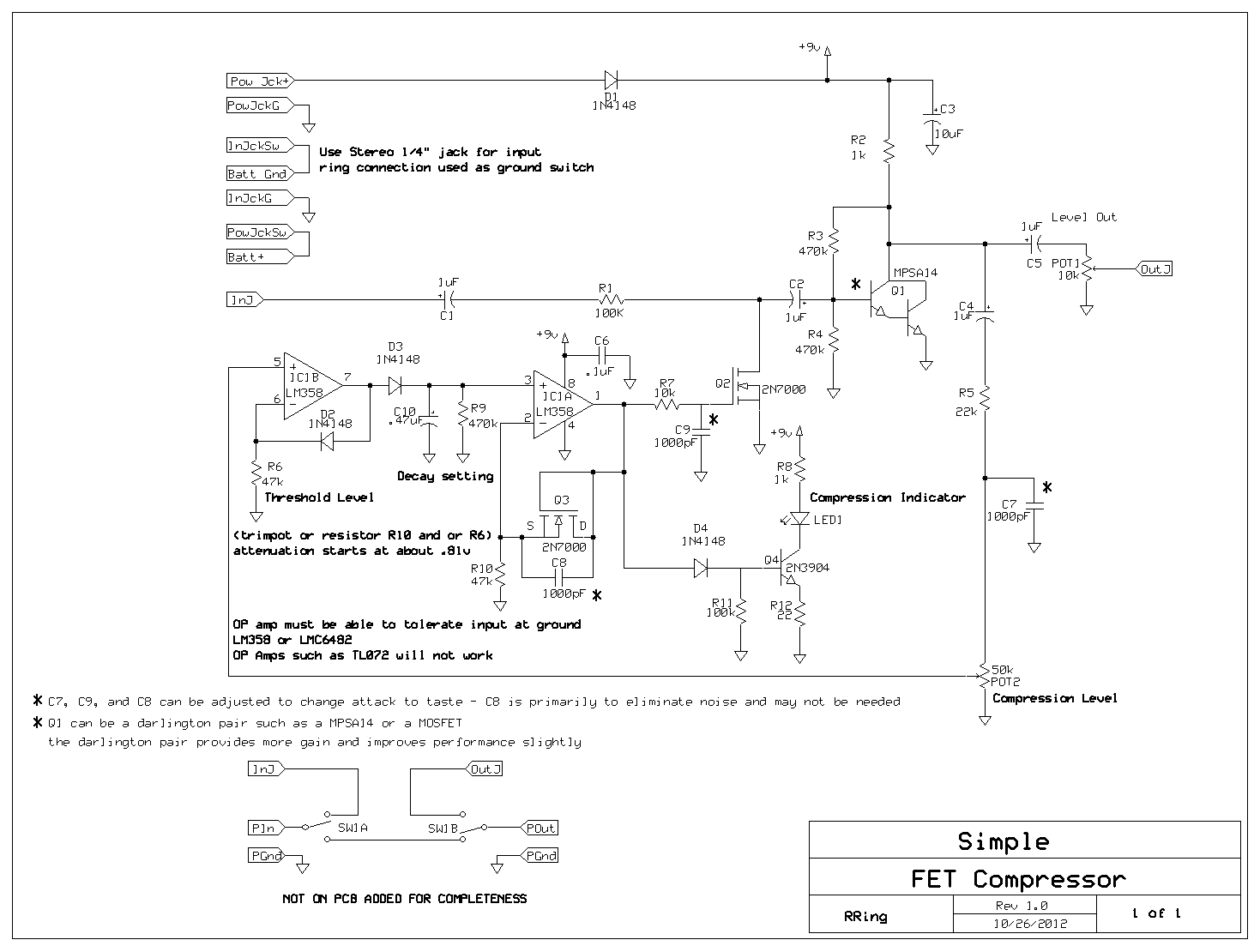
Another designer tried my mosfet compressor using a darlington pair as the gain stage  device Q1. He described some improvements in performance – so I tried this as well. I love it! Using a darlington such as a MPSA14 (or a homemade one) is a drop in replacement for the MOSFET Q1. It gives a little more gain and reduces noise in the control loop slightly (allowing more freedom in changing and or eliminating C7, c8, C9). I definitely can reccomend it.

New Schematic:

https://circuitsalad.com/wp-content/uploads/2012/11/mosfet-compressor1.gif