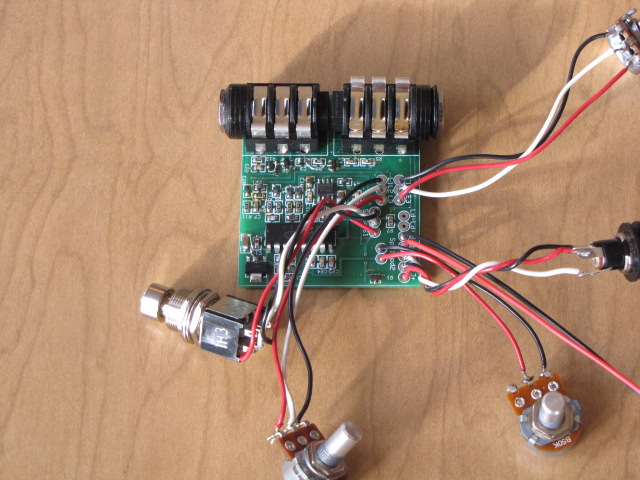
Check out the video demo of it in action:
http://www.youtube.com/watch?v=1c3BYFAABAw&feature=player_detailpage
Check out the video demo of it in action:
http://www.youtube.com/watch?v=1c3BYFAABAw&feature=player_detailpage
It occurred to me that if one is willing to sacrifice some flexibility in the decay length of my compressor design; that it can be simplified by removing the source follower and the Zetex current sensor. What this means is that the control voltage is only half wave rectified instead of full wave, but if you just increase the filter cap – the circuit should still work fine. The trade-off is that you get limited to longer decay times only, but for most guitar applications this is fine. I have not verified this circuit but I will do this soon. I am confident it will work well. Removing these parts may make it more attractive to the DIY builder.
New Schematic:
https://circuitsalad.com/wp-content/uploads/2012/09/compressor3.gif
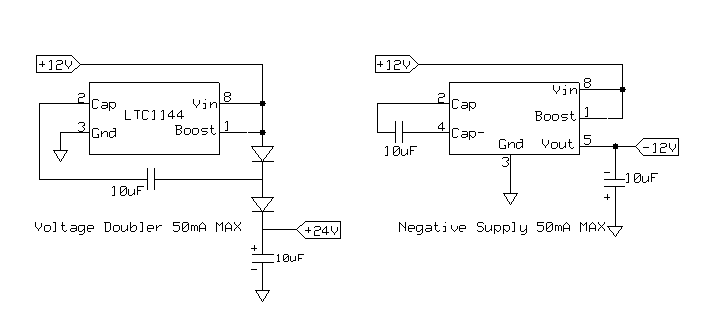
This IC is a switch cap charge pump the can source up to 50mA and can generate a negative supply from positve supply or can function as a voltage doubler. This thing is tough as nails and operates at 100KHz (easy to filter and above the audio range). It is over 90% efficient and requires two caps and maybe some diodes. I use it all the time for generation of dual supplies and doubled supplies for op amp circuits and high side nmos fet gate switching voltages. Check out the example circuits below. This IC solves all kinds of headaches with the addition of three or four parts to your circuit.
I am going to do PCB board layouts of some of these projects in using expresspcb.com’s free layout tool. I will use through hole parts as mush as possible. All the parts I spec will be available from digikey, mouser, mojo or small bear – no condor eggs! I will post the files and anyone who wants can mod the boards or order them as is from expresspcb. It will take me a couple of weeks – I want to be very careful and make sure I have no errors. So check back soon.
Yes its ugly – but it works great!
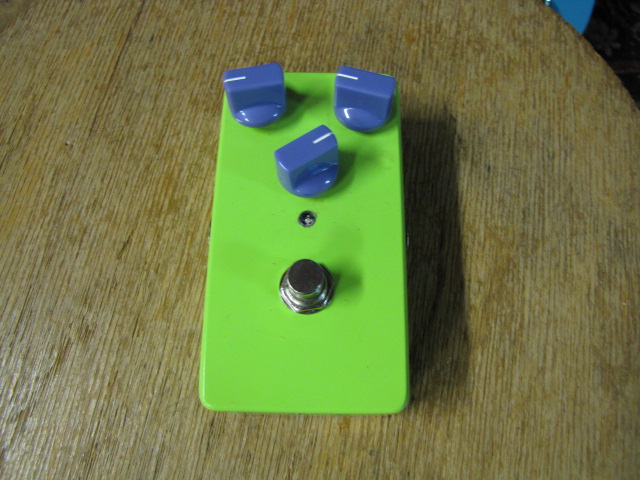
Check out the videos below. I have pooped out a slap back demo. You can get a really great 50’s tape echo sound
slap back
I have been building a lot of guitar electronics these days … and more to come I hope! Having said that, I think it is important to show how they can be used in real music and how well DIY designs can perform as compared to commercial products. My first demo is of my portable busking amp and my FET discrete signal chain compressor. This demo represents a classic jazz sound using the compressor to understate all of elaborate grips on the guitar and make the lines very smooth sounding even with heavy down strokes.
check it out at:
more demos to come shortly!
This covers the basic equations for noise and more advanced analysis but it distills down most of the analysis into good rules of thumb.
https://circuitsalad.com/wp-content/uploads/2012/09/noise-in-amps.pdf
The highlights include:
every 1K orf resistance adds 4nV/Hz noise.
noise adds as the sum of squares… so – larger sources dominate and large gain in the first stage minimizes noise contribution in later stages
Source impedance needs to be considered in terms of its effect on op map current noise( often ignored)
This is not a riddle but a painful reminder of how un-ideal a capacitor can perform in real world circuit conditions. I measured the capacitance and Q factor for these capacitors shown below on a Agilent 4263B LCR meter, using 100Hz and 100Khz frequencies.

From left to right the capacitors in the picture are:
1000uF electrolytic, .01uF ceramic, 10uF ceramic, .1uF tantalum
At 100Hz the results are as one might expect : 1007 uF, Q of 7 .014, Q of 100 8.6 uF , Q of 36 .104, Q of 80
The large electrolytic has a pretty low Q though indicating already at 100Hz its performance is starting to suffer
At 100Khz things get really interesting : The 1000uF is now -.1 uF which is actually an inductor! The .01uF is .0098uF and the Q has gone down to 35. The nominal 10 uF(8.6) is now 8.2uF- not bad but the Q is down to 3. Finally the .1uF tantalum is now a .05uF with a Q of 1.2.
So even with this modest change in frequency, we can see capacitance starts to decrease as stray inductance becomes more of an effect. Also all of the capacitors start to become more lossy( low Q).
The bottom line here, especially with regard to decoupling, one large cap will not work well in most applications. One may have to use a combination of different type and value capacitors to achieve intended results.
I have produced a PCB and built a new delay using the PCB and the original schematic. The results are gratifying. I did make a couple of minor adjustments. The board is designed to fit in a 1590b stomp box. It draws 20mA so it works pretty well on a 9V battery.
R12 – changed from 33K to 39K
R2- changed from 56K to 47K
c19- changed from 2000pF to 2200pF
c16- from 247pF to 300pF
PCB Picture:
https://circuitsalad.com/wp-content/uploads/2012/09/img_4882.jpg
Video Demo Here:
Updated Schematic:

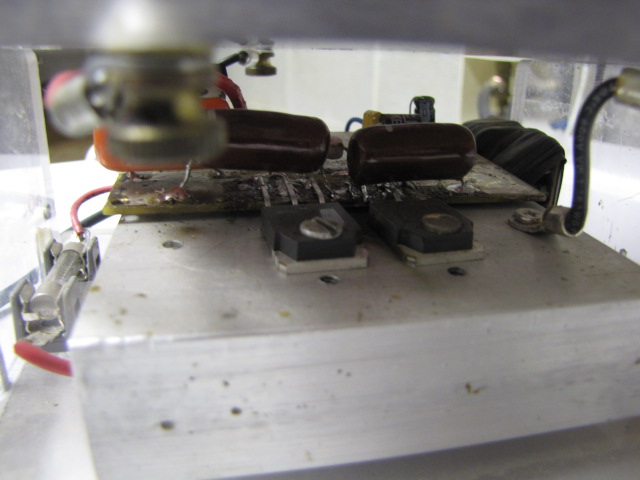
I have tried to figure out what exactly a Tesla Coil was for years. I finally occurred to me that the best way to think of a Tesla Coil was as a very high power rf transmitter simply with a terrible antenna. The secondary is really just an ultra shortened 1/4 wave antenna – so short it can barely radiate RF at all. Ultimately the energy boils off the top of this antenna as the discharge us mad scientists know so well.
To prove my conception of a Tesla Coil: I built a class E amplifier that is powered from a simple half wave rectifier and 120VAC straight from the wall. A class E amplifier is simply a power mosfet switched on and off by a square wave drive (highly non linear all on or all off). The trick is to load the output with a slightly out of tune resonant circuit with respect to the frequency of the pulsing. By doing this, the voltage and current waveforms become 90 degrees out of phase. Since power is current times voltage, if they do not overlap (or very little) as in the case of a class E amplifier; no power is dissipated across the semiconductor switch and efficiency can approach 90+ percent. The draw back of such an amplifier is that it is narrow band and must be critically tuned.
A Tesla Coil is ideal as a load for such an amplifier. If you check out the schematic below you will see it is shockingly simple (pun intended). The schematic is incomplete in that I do not show the driver circuit. The driver is nothing special – just a mosfet driver IC (there are a million of them out there) and a couple of 555 timers to create a modulated (30Hz 20% duty cycle) 300KHz pulse source. I can also just use my bench sine/square generator. The reason I modulate it at 30 Hz it is twofold, one, to give the crackly long streamers and two, if I run in continuous mode the resonant caps will explode from over heating, also the secondary overheats and starts melting, catching on fire ( both of these events happened to me).
While the design is simple, tuning is challenging – if the current and voltage are ever in phase… forget it. Get ready to blow some FETS!
Schematic: https://circuitsalad.com/wp-content/uploads/2012/09/class-e-tesla.gif
Pictures:
https://circuitsalad.com/wp-content/uploads/2012/09/img_48671.jpg
https://circuitsalad.com/wp-content/uploads/2012/09/img_48711.jpg
https://circuitsalad.com/wp-content/uploads/2012/09/img_48681.jpg
Video Link:
http://www.youtube.com/watch?v=tPK7-uS64IM&feature=player_detailpage
 Circuit Salad